Posts

Triads

Image
Lesson 7 October 27th, 2020 Lesson 7 Lecture notes: A triad is a set of three notes stacked in threes consisting of the Tonic ( 1 ), Mediant ( 3 ), and Dominant ( 5 ) There are four main qualities in triads : Major , minor , Augmented ( + ), and diminished ( o ). When numbering chords in music, you would use Roman numerals with upper case numbers being Major and lower case numbers being minor or diminished . For example ( I ) = M ajor , ( i ) = minor / diminished . The Roman numerals used in music are: 1 = I or i , 2 = II or ii , 3 = III or iii , 4 = IV or iv , 5 = V or v 6 = VI or vi , and 7 = VII or vii In diatonic major scales , chord ( I ) Major , chord ( ii ) minor , chord ( iii ) minor , chord ( IV ) Major , chord ( V ) Major , chord ( vi ) minor , and chord ( vii ) diminished . In a harmonic minor scale , chord ( i ) minor , chord   ( ii ) diminished , chord   ( III ) Major , chord   ( iv ) minor , chord   ( V ) M ajor , chord...
Intervals

Image
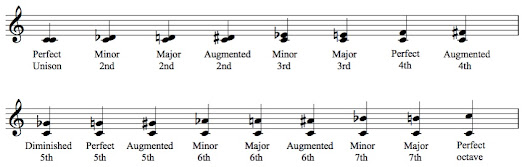
Lesson 6 October 19th, 2020 Lesson 6 Lecture notes: An interval indicates how much space there is musically between two separate note pitches . When naming an interval , you should always count the first and last letter names . If two notes share the same pitch with no distance between them , it would be unison . Melodic intervals are two note pitches moving in a successive pattern in a melodic line . Harmonic intervals are when two separate note pitches are played simultaneously at the same time . Musical quality can be described in five categories : perfect , major , minor , augmented , and diminished . Simple intervals are pitches smaller than an octave . Compound intervals are pitches   larger than an octave . To find compound intervals , simply add 7 to a simple interval . For example, a compound second would also be called a major ninth . Therefore, a major second plus 7 would give you a major ninth . The image above shows simple intervals in C major...

Diatonic Modes

Image
Lesson 5 September 28th, 2020 Lesson 5 Lecture notes: There are seven traditional diatonic modes . The mode that makes up the major scale is the Ionian mode , the  first degree of a given scale.  The mode that makes up the natural minor scale is the Aeolian mode , the  sixth degree of a given scale. The modes consist of seven types , including the Ionian , Dorian , Phrygian , Lydian , Mixolydian , Aeolian , and the Locrian mode , and in that  exact order from first to seventh . The two modes that sound almost identical are the Ionian mode and the Lydian mode . The only difference is that the fourth degree in the Lydian mod e is raised . Jazz is highly famous for the use and implementation of modes . The names given to modes are Greek .   The above photo shows the modes and the types of sound qualities/moods they make. The photo above shows the Lydian mode in C major ascending and descending two octaves with the raised fourth degree. The vid...

Minor Scales and Minor Keys

Image
Lesson 4 September 21st, 2020 Lesson 4 Lecture notes: To find the relative minor of a major scale , you would count up a major 6th from the tonic note . For example, C major . ( C , D , E , F , G ,  A ,   B , C ) . Therefore , A  would be the relative  minor to C major . To find the  relative major of a minor scale , you would count up a minor 3rd from the tonic note . F or example, A minor . ( A , B ,  C ,   D , E , F , G , A ) . C would be the relative major to A minor . Relative major and minor scales  share the same key signature , also known as relative keys . There are three different types of minor scales ;  natural , harmonic , and melodic . The natural minor shares the same key signature and accidentals as its relative major .  The harmonic minor shares the same key signature as its relative major . With the addition of raising the seventh degree .  The melodic minor shares the same key...

Major Scales and Major Keys

Image
Lesson 3 September 14th, 2020 Lesson 3 Lecture notes: A major scale is made up of 8 pitches Key signatures show which pitch has to be sharpened or flattened in a work Key signatures must be written in order of fifths for sharps and fourths for flats . The order of sharps in a key signature is F# , C# , G# , D# , A# , E# , B# . The order of flats in a key signature is Bb , Eb , Ab , Db , Gb , Cb , Fb . Major scales are constructed using a pattern of  " W ,  W , H , W , W , W , H "  ( W  = whole , H  = half) This picture shows the circle of fifths. This picture shows where the key signature is placed between the clef and the time signature. This video shows you how to create a major scale using a pattern of whole steps and half steps. This video shows the C major scale being played on the piano. This is a short-scale exercise in B flat major. This is a video of me playing the B flat major scale exercise at 90bpm.

Simple and Compound Meters

Image
Lesson 2 September 7th, 2020 Lesson 2 Lecture notes: There are two principal meter types: simple and compound.  Simple meters have beats that divide into two. and compound meters have notes that divide into three A meter signature or (time signature) at the beginning of a score establishes the meter type and beat unit. Time signatures are written with two numbers. One number is placed above the other. A triplet in music is a rhythm playing three notes in the space of two. These are some examples of simple meters you would find in music. These are some examples of compound meters you would find in music. This is an example of triplets in the meter signature of 4/4 time. This video illustrates simple meters and also a brief introduction to conducting patterns. The video above illustrates how a triplet is counted in the time of 4/4 using various beats. The above song is a musical excerpt from Mary Had A Little Lamb. This is me playing Mary Had A Little Lamb in 16th...

Introduction to Pitch Class

Image
Lesson 1 September 1st, 2020 Lesson 1 Lecture notes: There are three standard accidentals in music, inclusive of sharp, flat, and natural. Enharmonic equivalents are two notes with the same pitch but different names. (C# - Db) The distance between any two notes is called an interval. The C clef is movable. The point at where the curves join is middle C or C4. Ledger lines are used to write in notes above or below a given staff. These are the three commonly used accidents you would find in music. From left to right in the image above would be sharp, natural, and flat. The image above is an example of ledger lines ascending above and descending below the treble clef. The image above shows the C clef, which has middle C or C4 running through the joined. The video above is great for showing and explaining enharmonic equivalents. Here's me playing the chromatic scale ascending and descending one octave  beginning on B flat on the Trombone.