Posts

Fourth and Fifth Species Counterpoint

Image
  Lesson 14 February 16th, 2021 Lesson 14 Lecture notes: The fourth-species counterpoint introduces suspension , which is a harmonic dissonance that falls on a strong beat . The fourth-species counterpoint is an elaboration that uses rhythmic displacement or syncopation that ties a note from one bar to the next. A suspension  consists of three parts : preparation , suspension , and resolution . A suspension can be grouped into two categories : upper voice suspension , which includes 4-3 , 7-6 , and 9-8 , and lower voice suspension , which includes 2-3 , and 9-10 .  Consonant intervals can be tied to another consonant interval over the bar line in the fourth-species counterpoint. The fifth-species counterpoint includes the elements from all the previous counterpoints from first to fourth . The photo above shows a fourth-species counterpoint beginning on a P8. The photo above shows a fifth-species counterpoint beginning on a P8. The video above describes t...

Second and Third Species Counterpoint

Image
  Lesson 13 February 9th, 2021 Lesson 13 Lecture notes: The second-species counterpoint has two notes (2:1) to one note over the cantus firmus. The third-species  counterpoint has four notes (4:1) to one note over the cantus firmus. The second-species counterpoint has one strong beat on the first note  and one weak beat on the second note . The third-species counterpoint has two strong beats on beats one and three and two weak beats on beats two and four . In the second and third species , the strong beats must contain consonant intervals , and the weak beats may include consonant or dissonant intervals . The last note in the second species  should end on a strong beat or 1:1 . Passing tones are introduced in the second and third species counterpoint, which generally fall on weak beats and are approached in stepwise motion . The melodic motion should be primaril y stepwise when writing counterpoints.  The photo above shows a second-spe...

First-Species Counterpoint

Image
Lesson 12 February 3rd, 2021 Lesson 12 Lecture notes: The  first-species counterpoint consists of note-to-note intervals or 1:1 . There  is a corresponding whole note in the counterpoint line for every whole note in the Cantus Firmus . There are only strong beats in the first-species counterpoint, which require consonant intervals . Repeated fifths and octaves are only approached using contrary motion in the first-species counterpoint. Repeating notes or Oblique motion is not allowed to be used in the first-species counterpoint. The consonant intervals available to use in the first-species counterpoint are the PU (Perfect Unison) , M/m 3rd (Major or minor third) , P5 (Perfect fifth) , M/m 6th , (Major or minor sixth) , and P8 (Perfect eighth) . Dissonant intervals are not allowed in strict first-species counterpoints, which are the 2nds , 7ths , tritones , and 4ths . The above photo shows an eight-bar first -species counterpoint starting on a P8  (...

Introduction to Counterpoint

Image
Lesson 11 January 28th, 2021 Lesson 11 Lecture notes: There are four types of contrapuntal motion: (C) Contrary motion ,   (P) Parallel motion ,  (S) Similar motion,  and (O) Oblique motion . Contrary motion is when two parts move in opposite directions giving voices the most independence and balance . Parallel motion   is when both parts move in the same direction using the same interval . This is only allowed between imperfect consonances and not perfect consonances . Similar motion   is when both parts move in the same direction but using different intervals . This motion can be used freely except when approaching a perfect interval , which is only acceptable if the upper parts move by a step . Oblique motion   is when one part repeats or sustains a single pitch , and the other moves by either a leap , skip or step . This motion is acceptable ; however, it is not desirable because one part is required to be static . Perfect consona...

7th Chords Part 2

Image
Lesson 10 November 16th, 2020 Lesson 10 Lecture notes: Seventh chords are simply triads with an extra third stacked on top. The  MM7 would have a major triad + major third , creating the major 7th chord. The Mm7  would have a major triad + minor third ,  creating the dominant 7th chord. The mm7 would have a minor triad + minor third , creating the minor 7th chord. The ø7 would have a diminished triad + major third , creating the  half - diminished 7th chord. The o7 would have a diminished triad + minor third , creating the fully diminished 7th chord. Seventh chords that are uncommon are augmented triads with a major or minor seventh and a minor triad with a major seventh . In the Classical period , seventh chords were only built on chords 2 , 5 , and 7 . Jazz standards frequently end with unresolved seventh chords . The photo above shows all of the lead sheet symbols, including triads, sevenths, ninths, elevenths, and thirteenths. The p...

7th Chords

Image
  Lesson 9 November 9th, 2020 Lesson 9 Lecture notes: Seventh chords consist of four notes , including  a root , third , fifth , and seventh , all stacked together. There are five common qualities of seventh chords : the  Major   7th , minor   7th, Dominant   7th , Half diminished   7th and diminished   7th .   The abbreviations for seventh chords are Major 7th ( MM7 ), minor 7th ( mm7 ), Dominant 7th ( Mm7 ), Half diminished 7th ( ø7 ), and diminished 7th ( o7 ) The seventh chord in a Major diatonic key is half - diminished ,  but the seventh chord is  fully diminished   in  minor diatonic keys . The figured bass symbols for seventh chords are  root position ( 7 ), first inversion ( 6/5 ), second inversion ( 4/3 ), and third inversion ( 4/2 or 2 ). The photo above shows the five common qualities of seventh chords in the key of C Major. The photo above shows the seventh chord's numerous qualities and...

Figured Bass and Lead-Sheet Symbols

Image
Lesson 8 November 2nd, 2020 Lesson 8 Lecture notes: Inversions/Figured bass is indicated by three symbols inclusive of 5/3 ,   6/3 ,   or 6 and 6/4 . Inversions/Figured bass in a triad can be in either root position , first inversion , or second inversion . Root position is when the root note is in the bass. This is displayed with the symbol 5/3 . First inversion is when the third note is in the bass. This is displayed with the symbol 6/3 or 6 . Second inversion is when the fifth note is in the bass. This is displayed with the symbol 6/4 . The numbers in the figured bass symbols indicate which intervals are above the bass note . For example,  5/3  means that the intervals over the bass note are a fifth and a third . The above photo shows triad inversions in Root Position, First Inversion, and Second Inversion in C Major's key.  The above photo shows triad inversions in Root Position, First Inversion, and Second Inversion in all four quality soun...

Triads

Image
Lesson 7 October 27th, 2020 Lesson 7 Lecture notes: A triad is a set of three notes stacked in threes consisting of the Tonic ( 1 ), Mediant ( 3 ), and Dominant ( 5 ) There are four main qualities in triads : Major , minor , Augmented ( + ), and diminished ( o ). When numbering chords in music, you would use Roman numerals with upper case numbers being Major and lower case numbers being minor or diminished . For example ( I ) = M ajor , ( i ) = minor / diminished . The Roman numerals used in music are: 1 = I or i , 2 = II or ii , 3 = III or iii , 4 = IV or iv , 5 = V or v 6 = VI or vi , and 7 = VII or vii In diatonic major scales , chord ( I ) Major , chord ( ii ) minor , chord ( iii ) minor , chord ( IV ) Major , chord ( V ) Major , chord ( vi ) minor , and chord ( vii ) diminished . In a harmonic minor scale , chord ( i ) minor , chord   ( ii ) diminished , chord   ( III ) Major , chord   ( iv ) minor , chord   ( V ) M ajor , chord...

Intervals

Image
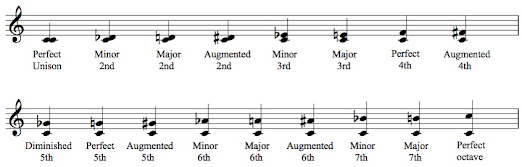
Lesson 6 October 19th, 2020 Lesson 6 Lecture notes: An interval indicates how much space there is musically between two separate note pitches . When naming an interval , you should always count the first and last letter names . If two notes share the same pitch with no distance between them , it would be unison . Melodic intervals are two note pitches moving in a successive pattern in a melodic line . Harmonic intervals are when two separate note pitches are played simultaneously at the same time . Musical quality can be described in five categories : perfect , major , minor , augmented , and diminished . Simple intervals are pitches smaller than an octave . Compound intervals are pitches   larger than an octave . To find compound intervals , simply add 7 to a simple interval . For example, a compound second would also be called a major ninth . Therefore, a major second plus 7 would give you a major ninth . The image above shows simple intervals in C major...